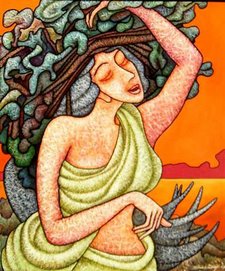
Nestled practically on the bank of the Nile, at No. 1 Kafour Street , is a beautifully restored mansion, that is home to an enviable Western European art collection. Once the home of Senate President Khalil Bey and his French wife Emilienne Hector, the contents of the museum are a tribute to the Khalils' passion for art, and perhaps Emilienne's desire to be considred creme de la creme of Cairo's high society!

Mahmoud Khalil Bey, a lawyer by profession, would later go on to become a senior statesman and later senate president.

Emilienne Hector, born into a French family, worked in the French theatre for a while, was known for her passion for being over dressed especially as far as her jewels were concerned.

It is said that Khalil Bey was enamored with everything French. French wife, French cuisine, French theatre, French culture, French architecture and thanks to his wife, French art! That would explain the huge collection of French artists that the museum houses.
This collection would have remained in private hands, had it not been for the fury of a woman scorned! In his old age, Khalil Bey became enamoured of a much younger and beautiful Egyptian lady, and, supposedly had a male offspring from this association, something that Emilienne had been unable to give him. While Khalil Bey's will bequeathed the house and the art collection to Emilienne, she wasn't willing to forget and forgive. Consequently, she bequeathed the entire collection to the State upon her death!
So I guess one needs to thank Khalil Bey for his promiscuity for being able to view this collection in Cairo!
No 1 Kahfour Street houses a number of very famous French painters like Champmartin, Daumier, Ricard, Delacroix and Toulouse Lautrec, Renoir, Monet, Pissaro, Trovon, Sisley, Millet, Moticelli, Milot, Diaz de la Penas,a and, not to forget Van Gough.
There is a painting "Jeune Fille Assise" by Morisot Berthe Marie which is very remniscent of Renoir.
You are not allowed to take photographs so I tried to look up the paintings on the net. Except for a few paintings, the images are not available, probably given that this was a private collection.
There are signed replicas of sculptures by Rodin. The ones to especially see are The Thinker and The Head of Victor Hugo.
There is a painting "Fatima au Odalisque" by Jeane Auguste Ingres (see below) which intrigued me due to the name (given that it was a nude)..

I thought "el Nil" by Eugene Fromentin, depicting a group of girls on a bank of this mighty river with a fortress visible on the other side, is also very striking. Pissarro's Cricket in Bedford Park is nice.
And I absolutely loved Monet's Westminster Abbey. A part of his London series, it shows Westminster Abbey through the typical London mist, and its hazy reflection in the waters of the Thames.
Renoir's Pommes et Poires and Tasse et Mandarines are ok.
Also a must see is The Singing Lesson by Toulouse Lautrec.

I think the piece de resistence of the museum is the painting "Life and Death" by Paul Gaugin. Valued at 10USD million, (or thats what I was told)the painting was a part of the Gauguin exhibition in Rome and was returned to the museum only in March this year. Am glad I did not go earlier. Would have hated to miss this!

In the painting a naked female bather with red hair, is looking at her arm, over which is draped a cloth, while another girl has her head in her hands, her legs raised, her elbow on her knees, holding her head. Obviously, the girl in warm red hues represents life, while the one in death-like blue represents death.
There is also a beautiful Van Gogh "Rhythm and the Poppy Flower" but I think I preferred the Gauguin.
The place is well maintained and beautifully restored. Wonder what it must have been like to stay here? Imagine the confusion in deciding the room that you wanted to occupy? Mercifully, they had no kids, or Emilienne might have had to spend her time running around looking for them!
Another word of caution. The paintings are catalouged in French, so you don't have a clue to their names unless you've read about it earlier! Or if you know French! They are supposed to have some literature in English, but the guy apologetically shrugged his shoulders saying that he had run out of them!
The museum offers you reproductions of Life and Death and a couple of other paintings, so I ordered one. At 30 LE its a steal, except that the quality is not really good. Its been simply printed on canvas, not the quality that you can pick up at other big museums. But hey, I liked Life and Death so much, that even this was welcome!
If you enjoy Western European art, do go visit the museum, its worth the time that you spend. The ticket is priced at LE 25, but if you are a resident, you get to pay only LE 12. Open from 10 am to 5.30 pm, its closed on Mondays.
Location: On the corner of Giza Street & Kafur Street next to the state council (Maglis al Dawla).

 Emilienne Hector, born into a French family, worked in the French theatre for a while, was known for her passion for being over dressed especially as far as her jewels were concerned.
 It is said that Khalil Bey was enamored with everything French. French wife, French cuisine, French theatre, French culture, French architecture and thanks to his wife, French art! That would explain the huge collection of French artists that the museum houses.